Galaxy Watch Lock Screen

Galaxy Watch Lock Screen

Multimodal Interaction

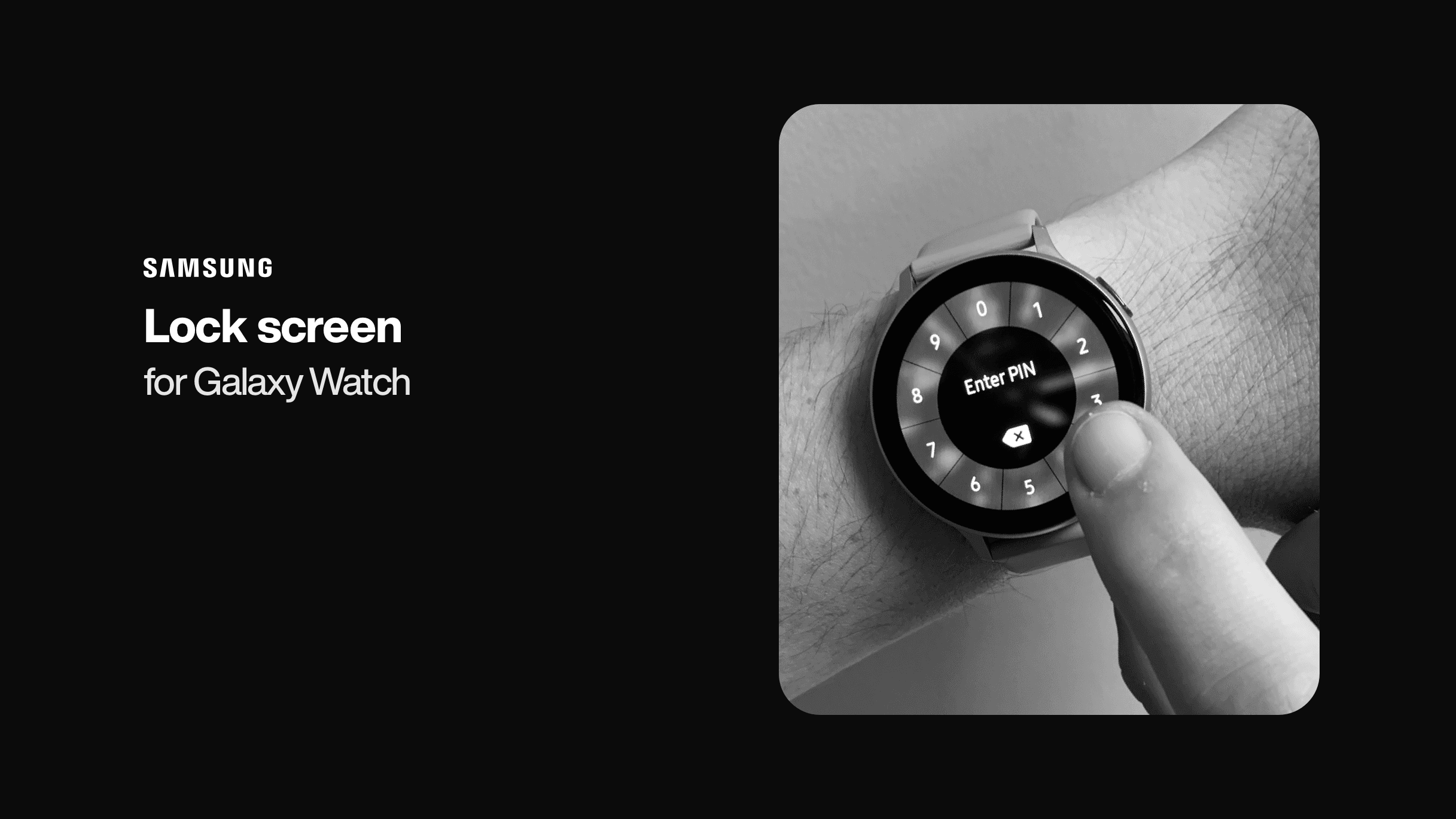
I explored how Galaxy Watch security could become easier to use without weakening protection. The work improved touch targets for PIN entry and introduced a tactile passcode concept that uses the watch bezel, haptics, and directional input.

Duration

2022

Company

Samsung

Role

Product Designer

Scope of work

Wearable interaction, PIN entry, accessibility, prototyping, usability testing

Multimodal Interaction

I explored how Galaxy Watch security could become easier to use without weakening protection. The work improved touch targets for PIN entry and introduced a tactile passcode concept that uses the watch bezel, haptics, and directional input.

Duration

2022

Company

Samsung

Role

Product Designer

Scope of work

Wearable interaction, PIN entry, accessibility, prototyping, usability testing

Context

Context

Security on a Small Circular Screen

Galaxy Watch offers PIN and pattern lock screens for privacy and for features such as Samsung Pay. The security requirement made the quality of the unlock experience especially important: if entry felt too difficult, users could avoid both the lock screen and the services that depended on it.
Galaxy Watch examples of PIN and pattern lock screens.

Context

Context

Security on a Small Circular Screen

Galaxy Watch offers PIN and pattern lock screens for privacy and for features such as Samsung Pay. The security requirement made the quality of the unlock experience especially important: if entry felt too difficult, users could avoid both the lock screen and the services that depended on it.

Problem

Problem

A Keypad That Did Not Fit the Hardware

Usage data showed that pattern unlock was far more common than PIN entry, even though Samsung Pay required a PIN. The existing keypad copied a phone pattern onto a much smaller display, creating tiny, crowded targets that demanded too much focus and were especially difficult with gloves.

Analysis of crowded PIN buttons and improved touch targets on a Galaxy Watch.

Problem

Problem

A Keypad That Did Not Fit the Hardware

Usage data showed that pattern unlock was far more common than PIN entry, even though Samsung Pay required a PIN. The existing keypad copied a phone pattern onto a much smaller display, creating tiny, crowded targets that demanded too much focus and were especially difficult with gloves.

Exploration

Exploration

Turning the Bezel Into a Combination Lock

The physical bezel produces tactile clicks as it rotates. I explored using those clicks like a combination lock, allowing a user to enter directional passcodes without relying on tiny on-screen buttons. The idea could also extend to a virtual bezel with haptic feedback.

Concept diagrams showing a rotating Galaxy Watch bezel used to enter a tactile passcode.

Exploration

Exploration

Turning the Bezel Into a Combination Lock

The physical bezel produces tactile clicks as it rotates. I explored using those clicks like a combination lock, allowing a user to enter directional passcodes without relying on tiny on-screen buttons. The idea could also extend to a virtual bezel with haptic feedback.

Interaction

Interaction

Three Ways to Enter a PIN

Numbers are arranged around the circular display to match the watch hardware. Users can rotate the physical bezel, swipe a virtual bezel, or tap the number directly. Each method uses the same spatial model, keeping the interaction predictable across devices and preferences.

Circular PIN layout demonstrating physical bezel rotation, virtual bezel swiping, and direct touch.

Interaction

Interaction

Three Ways to Enter a PIN

Numbers are arranged around the circular display to match the watch hardware. Users can rotate the physical bezel, swipe a virtual bezel, or tap the number directly. Each method uses the same spatial model, keeping the interaction predictable across devices and preferences.

Scenario

Scenario

Mixing Input Methods in One Flow

A user can complete a passcode with any combination of rotation, swiping, and tapping. The scenario demonstrates how the same four-digit PIN can be entered fluidly while preserving clear feedback after each selection.
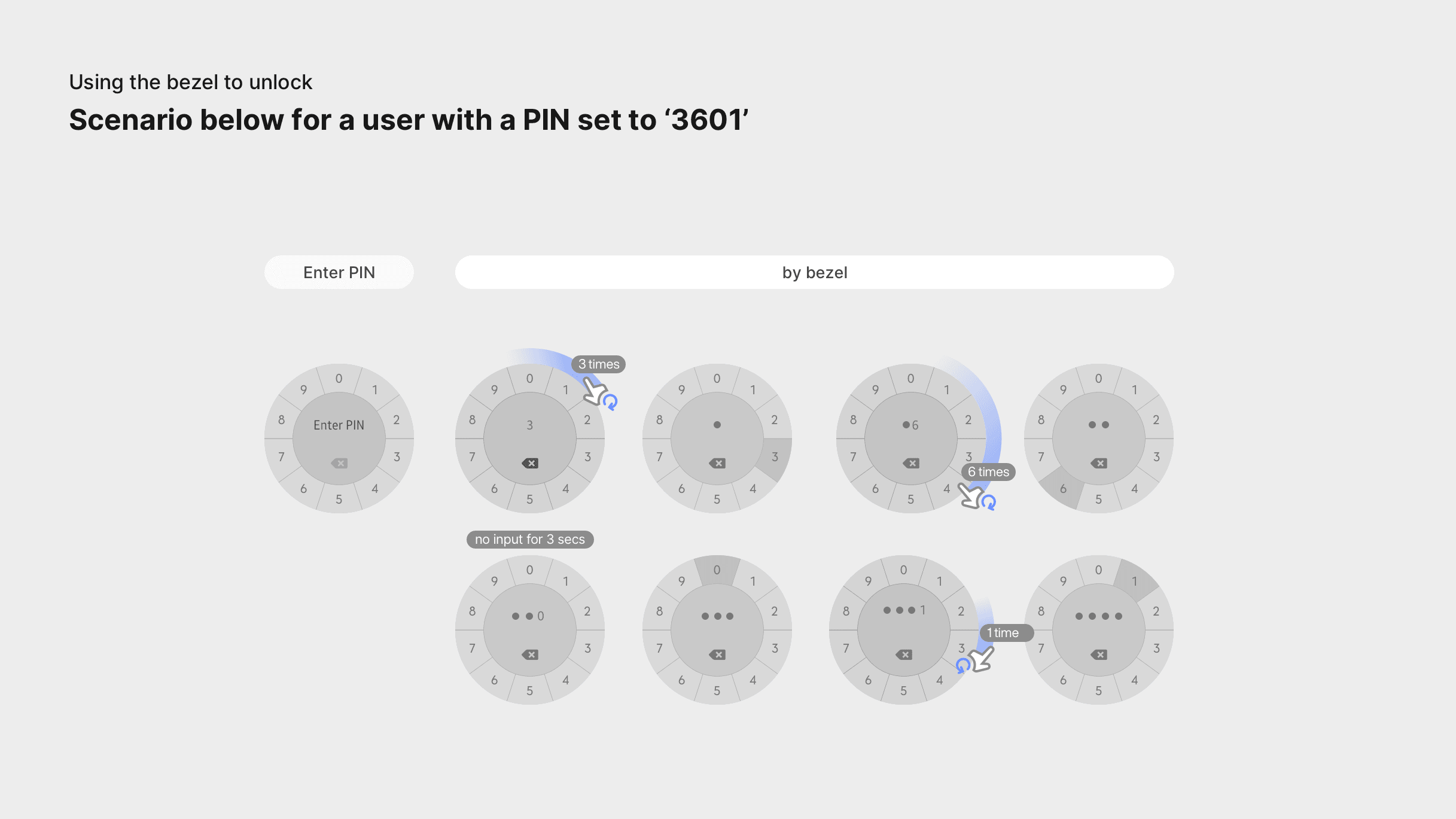
Step-by-step Galaxy Watch passcode scenario combining bezel rotation, swiping, and tapping.

Scenario

Scenario

Mixing Input Methods in One Flow

A user can complete a passcode with any combination of rotation, swiping, and tapping. The scenario demonstrates how the same four-digit PIN can be entered fluidly while preserving clear feedback after each selection.

Accessibility

Accessibility

Supporting PIN and Pattern Preferences

The final interaction family preserves both PIN and pattern methods while improving their fit for a round watch. Larger targets, circular movement, and multiple input options make secure entry more adaptable to different motor needs and contexts.

Galaxy Watch PIN and pattern behaviors with circular layouts and accessibility considerations.

Accessibility

Accessibility

Supporting PIN and Pattern Preferences

The final interaction family preserves both PIN and pattern methods while improving their fit for a round watch. Larger targets, circular movement, and multiple input options make secure entry more adaptable to different motor needs and contexts.